The Agentic Operating System (AI & Assistants)

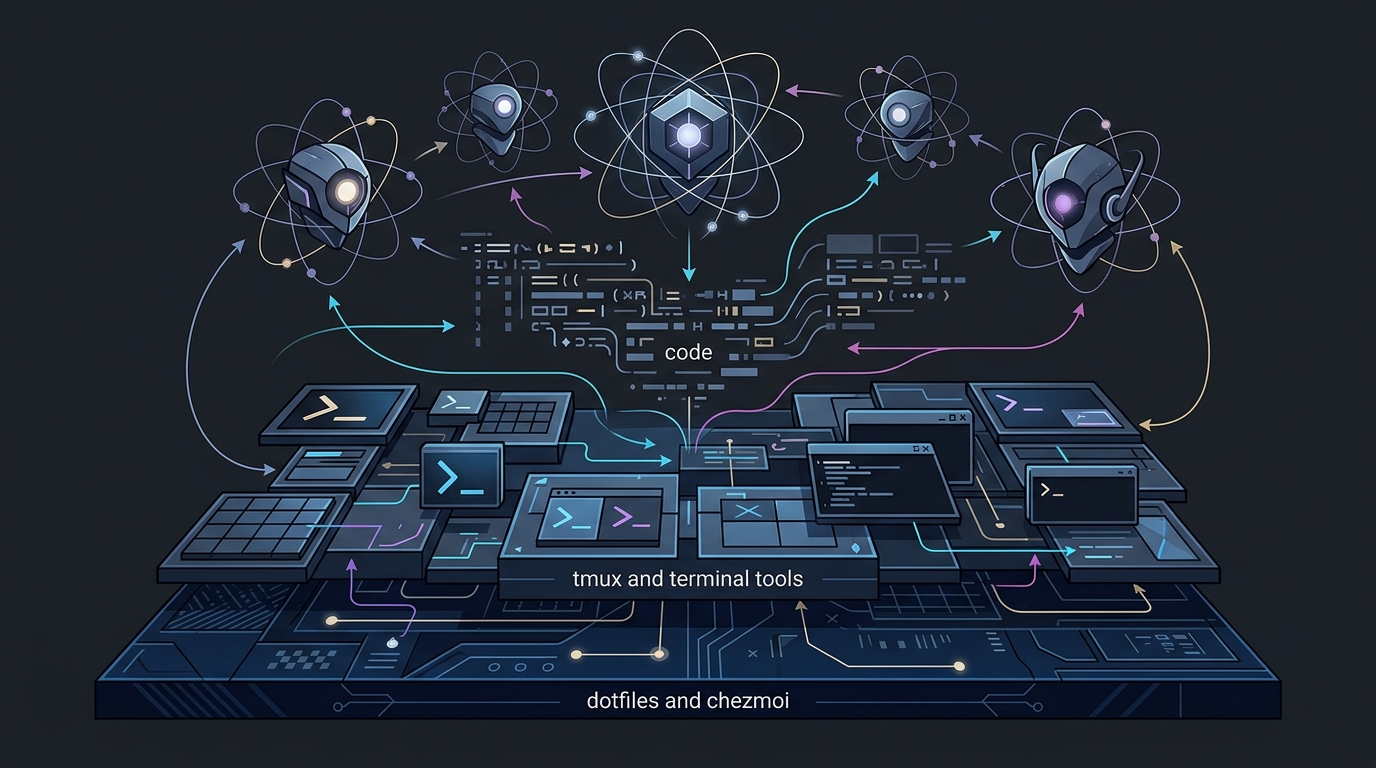
This setup does not just provide you with AI chat tools; it implements an Agentic Operating System. This treats "how my assistants should work" as strict, version-controlled configuration that is installed alongside everything else. The goal is deterministic, verifiable behavior instead of relying on unpredictable LLM heuristics.

This page is the governance hub: the SOP entrypoints, skills, and shared workflows that apply across every tool. Each subsystem (Ralph, MCP, model registry, memory, llama.cpp, per-tool configs) has its own page — see Subsystems.

The Governance Layer (SOPs)

Entrypoints installed into your home directory:

SourceTargetNotes
home/readonly_AGENTS.md~/AGENTS.mdThe single SOP source — edit only this
home/symlink_CLAUDE.md~/CLAUDE.mdSymlink to ~/AGENTS.md
home/dot_gemini/symlink_GEMINI.md~/.gemini/GEMINI.mdSymlink to ~/AGENTS.md
home/dot_cursor/symlink_AGENTS.md~/.cursor/AGENTS.mdSymlink to ~/AGENTS.md
home/dot_config/opencode/symlink_AGENTS.md~/.config/opencode/AGENTS.mdSymlink to ~/AGENTS.md

These files are policy entrypoints; skills are installed separately. There is one real SOP file (~/AGENTS.md); Claude, Gemini, Cursor, and OpenCode all read symlinks that resolve to it, so the SOP is identical across every harness by construction.

Shared SOP handling rules:

  • The entrypoints do not declare their own global instruction hierarchy. They define local SOP selection only: check the closest repo-local AGENTS.md first, then the broader home-level entrypoint, and defer to the runtime's higher-priority instruction layers when conflicts exist.
  • "Questions" is scoped to information-seeking asks. Requests phrased as questions still count as action requests when the user is asking for investigation, verification, or edits.
  • A mandatory compatibility gate runs before edits; see the SOP entrypoints for the exact classification, decision table, and summary-line format.
  • If uncertainty remains after local inspection, probes, and any required skills, ask one direct fork-closing question.

Shared git push safety rule:

  • If the user asks to push, agents must treat that as git push --force-with-lease (not plain git push).
  • Agents must never auto-run git pull, git pull --rebase, git rebase, or git merge as a pre-push reconciliation step.
  • If push is rejected due to divergence/non-fast-forward/lease checks, agents must stop and wait for explicit user direction.
  • Canonical source: home/readonly_AGENTS.md (the single SOP; ~/CLAUDE.md and ~/.gemini/GEMINI.md are symlinks to it), and home/exact_dot_agents/exact_skills/exact_git/readonly_SKILL.md.

Shared runtime verification rule:

  • For "is this correctly set up / working / actually being used" questions, the SOP now owns the canonical end-to-end verification rule, not just config inspection.
  • Required chain: source config, rendered/applied config, runtime consumer, and a minimal safe live probe when one is possible.
  • The shared rule is tracked in the single SOP: home/readonly_AGENTS.md (~/CLAUDE.md and ~/.gemini/GEMINI.md are symlinks to it).

Shared behavioral disciplines (integrated from forrestchang/andrej-karpathy-skills without duplicating existing SOP rules):

  • 2 Core Principles: surface material assumptions and competing interpretations rather than picking silently (evidence-first from 2.1 still wins — probe locally before asking); push back when a simpler approach satisfies the stated goal.
  • 3.3 Success Criteria & Verification Loops: reframe imperative tasks as verifiable goals (test-first / reproducer-first when practical); multi-step plans must carry per-step verify checks; does not override 2.0, 2.1, 2.2, or 5 Minimal edit scope.
  • 3.4 State-Machine Verification: for stateful, parser-like, or branch-heavy behavior, build a disposable /tmp/state-machine-verification/<pwd>/<topic>/<slug>/ harness before calling the change final; <pwd> scopes to the worktree, <topic> separates unrelated work in long-lived/default checkouts, and <slug> names the behavior under test. Each harness includes a manifest so agents reuse existing state-machine work only when target, branch/base/head refs, requested behavior, and compatibility intent still match.
  • 5 Code Quality: simplicity discipline (no speculative abstractions/flexibility/impossible-scenario error handling; senior-engineer test); artifact necessity (prove behavior is missing without a new artifact before adding it unless explicitly requested); dead-code handling (remove only orphans your own changes created; mention, don't delete pre-existing dead code unless asked).
  • Canonical source: home/readonly_AGENTS.md (the single SOP; ~/CLAUDE.md and ~/.gemini/GEMINI.md are symlinks to it), and the dotfiles repo-local AGENTS.md.

Skills Layout

All routable files live under ~/.agents/skills/. Each skill folder contains a SKILL.md entrypoint (and optional references/ for sub-modes).

Source of truth (this repo, chezmoi-managed):

Entry contract standard:

  • Each skill should make four things obvious near the top: Use when, Do not use, First actions, and Output.
  • The description frontmatter field is the primary routing signal — agents use it to decide whether to load the skill. Keep it concise, specific, and include non-obvious trigger words.
  • For manual-only skills with disable-model-invocation: true, the description is catalog metadata rather than an automatic routing trigger.
  • Skills gated to specific repos (e.g. elastic-only) must state the constraint in the description so agents skip them early.
  • The goal is to remove implied routing and implied next steps so the agent has less room to "remember roughly" and skip the file.

Current skills (33; sorted by name; routing from each skill’s disable-model-invocation frontmatter):

SkillUse whenRoutingGated to
ai-kbRecall or persist durable cross-session knowledge (gotchas, decisions, patterns, facts) via ,ai-kb; not ephemeral /tmp/specs context or code searchauto
blackboardRun-scoped shared typed ledger for multi-agent fan-outs via ,blackboard (findings + signal queue + synthesis gate + survival check); not durable knowledgeauto
buildkiteBuildkite CI status, builds, logs, pipelines, or a buildkite.com URL (use bk CLI; do not fetch URLs in-browser)autoelastic org
cli-skillsCreating or upgrading a CLI tool skillauto
compose-issueDrafting an issue title and body as text before create/edit (no gh side effects)auto
compose-prDrafting a PR title and body as text before create/edit (no gh side effects)auto
communicationCanonical tone/style for any human-directed content (PR/issue threads + bodies, Slack, email, chat, release/commit messages); referenced by other skillsauto
gitLocal git operations (branch, commit, push, rebase, merge, conflicts); not GitHub mutations or worktreesauto
githubAny GitHub mutation via gh (PRs, issues, comments, reviews, labels, releases, merges); not draft-only or review analysisauto
google-workspaceGmail / Drive / Calendar / Admin / Docs / Sheets via gws CLIauto
improve-branchOne evidence-backed improvement proposal for the current branch, PR, or issue goalmanual
improve-codebaseOne evidence-backed improvement proposal for the whole codebasemanual
improve-localOne evidence-backed improvement proposal for local changesmanual
improve-targetedOne evidence-backed improvement proposal for a targeted dir, module, or componentmanual
interview-meReverse-interview until intent is fully clear (not what the user thinks they should want)manual
jscpdDuplicate-code detection during refactor, cleanup, or DRY workauto
kbn-backportRun an e2e Kibana backport for a PR (asks for the PR number if missing): compute targets, drive the interactive tool in a tmux pane, resolve conflicts, open PRsmanualelastic/kibana
kibana-console-monacoAutomate or test the Kibana Dev Tools Console Monaco editor in a real browserautoelastic/kibana
kibana-labels-proposePropose labels, backports, and version targeting for a Kibana PR/issue (propose only; no posting)autoelastic/kibana
knipUnused files, dependencies, or exports in JS/TS projectsauto
letsfgFlight search via local LetsFG CLI (fares, routes, dates; direct booking URLs)auto
nano-bananaGenerate an image from a text prompt via ,nano-banana (Gemini image model)auto
playwriterBrowser control via Playwriter when "playwriter" is explicitly mentionedauto
present-prBuild and open a self-contained HTML scrollytelling walkthrough of a PR or local diff (not code review)manual
ralphDrive ,ralph go / tmux Ralph (spawn, verify, attach, replan, orchestrator roles)auto
researchInvestigate a third-party repo by cloning and reading source (GitHub URL or "how does X work")auto
reviewReview local changes or a PR; continue review, address threads, recheck PR changesauto
semEntity-level git diff, blame, impact, or token-budgeted context via sem CLIauto
semantic-code-searchSCSI semantic search, base-branch context, index selection, or another skill requires semantic base contextauto
standup/standup or prepare/post a #kibana-management standup from Slack + GitHub since last post (post only after approval)manual
walkthroughInteractive codebase exploration: trace flows, map components, render architecture diagramsmanual
weaveEntity-level merge preview or conflict resolution via weave CLIauto
worktrees,w / ,gh-worktree worktree create, switch, list, prune, or checkout PR/issue locallyauto

Worktree note for agents: when creating a worktree from a GitHub issue, prefer ,gh-worktree issue <owner/repo> <issue_number> --branch <branch-base-name> so repo resolution/bootstrap happens before the lower-level ,w issue metadata and branch creation flow.

PR/issue composition hygiene:

  • compose-pr, compose-issue, and github sanitize public GitHub text before drafting or posting.
  • PR/issue bodies must avoid session-specific local references such as private hostnames, non-standard local domains, absolute workspace paths, /tmp/... files, browser automation session names, and local usernames.
  • Repro-driven PRs must include portable local reproduction steps in the test plan, not only the agent's local validation notes. Prefer generic setup such as local Kibana, http://localhost:5601, or explicit role/user creation steps that another reviewer can run.

Always-on rule source:

  • The SOP entrypoints are the only canonical always-on mechanism for assistant behavior.
  • Do not encode mandatory every-prompt rules as skills; OpenCode skills are on-demand, not guaranteed every turn.
  • Keep mandatory completeness and no-guessing rules in the single SOP: home/readonly_AGENTS.md (~/CLAUDE.md and ~/.gemini/GEMINI.md are symlinks to it).

Source-First Research

  • Explicit external repo-inspection requests now route to the same source-first skill instead of a separate variant.
  • The research skill now requires: resolve repo/ref first, then inspect the checked out source locally.
  • Source-first research now resolves the target ref before inspecting code.
  • Use the default branch only for current/latest behavior questions.
  • For version-, branch-, tag-, or commit-specific questions, inspect that exact ref instead of defaulting to latest upstream.

Core Workflow: Change A Skill

  1. Edit files under:
  1. Apply and verify:
chezmoi diff
chezmoi apply
ls -la ~/.agents/skills

Subsystems

The agentic layer is split into focused pages:

  • Review workflow — how the review skill reviews your code (base context, truth-validation loop, reply style, router, publication gate).
  • Agent memory — hook memory (/tmp/specs, ,agent-memory) and the durable AI knowledge base (,ai-kb).
  • Ralph orchestrator — the ,ralph go planner/executor/reviewer/re-reviewer loop, roles, and tmux control plane.
  • MCP servers — the canonical mcp_servers.yaml registry and per-tool generation.
  • Model registry & routingai_models.yaml, per-tool model generation, and LiteLLM.
  • Tool configs — Cursor CLI, profile-based merging, per-assistant settings (Claude/Gemini/Pi/Codex/OpenCode/Copilot/Amp), and the RTK token-optimization layer.
  • llama.cpp local inference — local GGUF server, model router, and the Claude/Codex/OpenCode/Pi launchers.
  • Reviewing agent diffs — the tuicr loop for feeding structured feedback back to an agent.

Safety Boundaries

  • Keep assistant instructions declarative and repo-local.
  • Keep secrets in pass (or local private config), not in tracked markdown.
  • Validate generated automation commands before running state-changing actions.
  • Treat RTK-compacted command output as a recoverable index, not the full output: when a result shows [full output: …] or … +N more, fetch the full output before relying on it (~/CLAUDE.md §2.4; RTK wiring).

Verification And Troubleshooting

High-signal checks:

chezmoi diff
chezmoi apply
ls -la ~/.agents/skills

If assistant behavior is not picking up expected instructions:

  • verify the correct entrypoint file exists in $HOME (~/AGENTS.md, ~/CLAUDE.md, ~/.gemini/GEMINI.md).
  • verify skill files exist under ~/.agents/skills/.
  • verify secrets expected at runtime are present in pass.